
Step-by-Step Guide to Completing IGNOU Projects and Dissertations
페이지 정보
작성자 Wilson 작성일26-01-30 10:19 조회13회 댓글0건관련링크
본문
It can be difficult to complete an IGNOU project or dissertation can feel overwhelming at first. Many students put off starting because they think it's an overwhelming task with many rules. However, once you know the structure and follow a clear step-bystep strategy, it's easier to handle. This guide walks you through the process in practical terms so that you can organize, write, and submit the project without unnecessary stress.
Understanding the Purpose of an IGNOU Project
Before jumping into the project, make sure to know the reason for its existence. IGNOU projects are not simply assignments to earn points. They test your capacity to study, analyze, and present data in a logical manner. No matter if you're taking an MBA, MCOM, B.Ed or another program, the assignment will test how you're able to apply theoretical ideas to the real world.
A dissertation or project permits you to look into a particular topic in depth, develop analytical thinking, and demonstrate your understanding of the subject. In many cases projects that are well-written can also serve as a benchmark to your future job.
Step 1: Choosing the Right Topic
The primary obstacle for students is choosing a subject. A well-chosen topic can help save many weeks of work. Your subject should be:
relevant to the course It is important to ensure that it's in line with your course syllabus and core concepts.
Feasible Choose a topic that you can complete within the time frame and resources available.
Interesting You'll have to spend weeks investigating it, so you should choose something that's going to keep you intrigued.
For instance, if seeking to study MCOM the subjects you'll be studying like "Impact of Digital Payments on Consumer Behavior" or "Role of Microfinance in Rural Development" are relevant and research-able.
If you feel stuck it is possible to look up The IGNOU Solved Project examples online to find inspiration. These aren't a replacement for your own work however they will help you understand the format and the scope of a successful project.
Step 2: Understanding the Guidelines
Each IGNOU project comes with its own set of guidelines for the word count, formatting and submission rules. Missing even one detail can affect your evaluation. Make sure you download the official project guide for your course on the IGNOU website. It is important to pay attention to:
The word count generally between 3000 to 5000 word, in accordance with the course.
Formatting Use clear headings, subheadings, and proper page numbering.
Referencing Properly reference all sources. IGNOU prefers APA as well as Harvard style.
The submission format Most courses require a printed copy of the course along with one that is soft on a CD or pen drive.
Afflicting these rules on projects is a common reason projects get delayed or rejected.
Step 3: Conducting Research
If you've decided on a topic then the next step is the research. Research is the essential element of every project. Without reliable data and insight the project will seem incomplete.
Where to start:
Study materials and books: Start by reading your IGNOU textbooks and reference books listed in your syllabus.
Articles and online journals Web sites like Google Scholar, ResearchGate, and JSTOR can help you find credible research.
Surveys and interviews For practical courses gathering primary data from respondents is valuable and unique.
When researching, keep a simple document or notebook with the most important points and sources. This will make writing easier later on.
Step 4: Structuring Your Project
A common error students make is jumping straight into writing without planning. An organized structure keeps your work organized and easily read. Here's a standard structure which can be used in most courses:
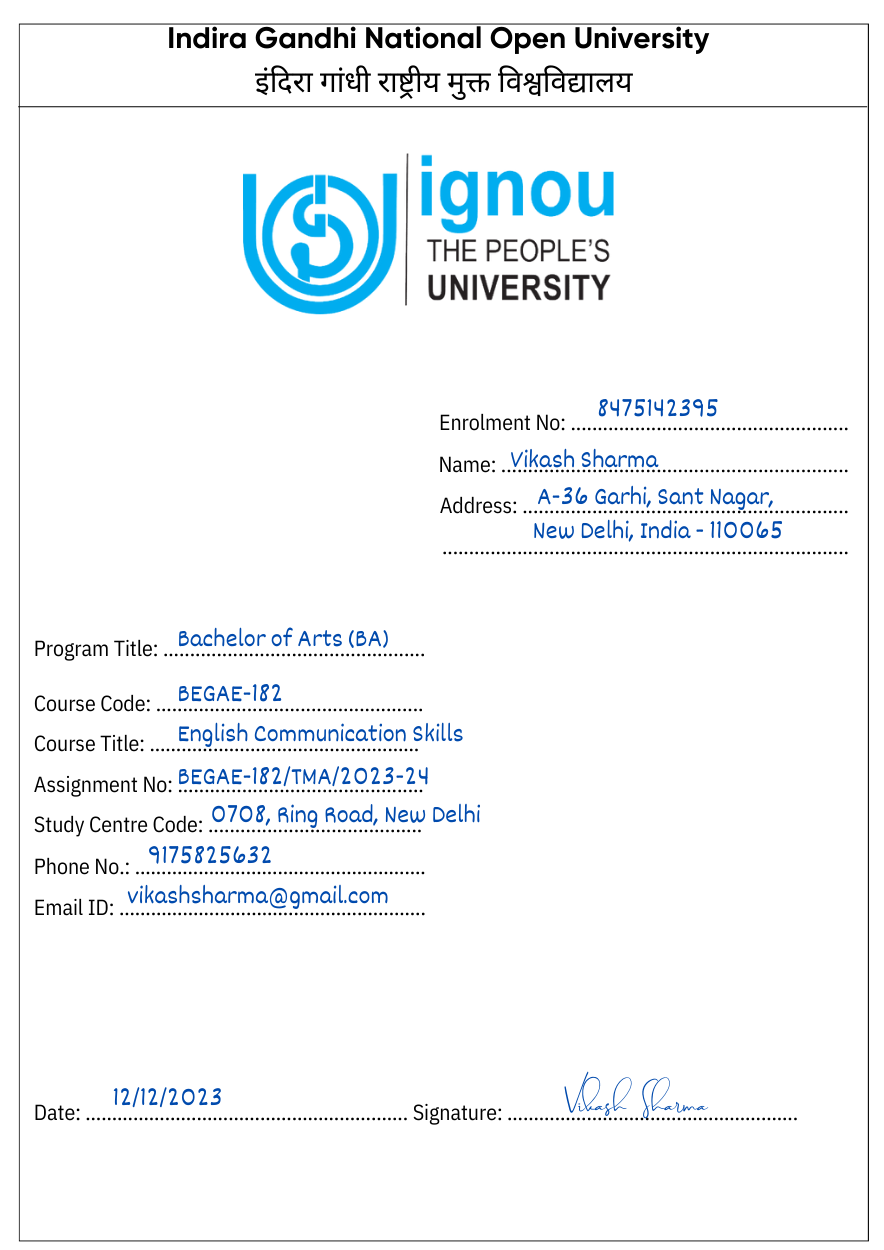
Title Page It includes your name an enrollment number as well as your course, and the title of your project.
Acknowledgment Thank your guide you have worked with, your coworkers or anyone who has helped. Keep it simple and sincere.
Certificate: Most courses require a certificate signed by a guide confirming originality.
Abstract Description: A short summary of your project that outlines the goals, methods, and conclusions.
Introduction Define the background of your topic, objectives as well as research-related questions.
Literature Review: The summaries of research and studies that are related to your topic.
Methodology Be specific about the methods you used to collect data, sampling size, tools utilized and the analysis methods.
Analysis and Discussion Analyze and discuss your findings clearly. Utilize charts, tables, or graphs where necessary.
Conclusion and Recommendations: Wrap up this study, highlight the most important conclusions, and suggest concrete implications.
References: List all the sources referenced in a format that is appropriate.
Appendices that include survey questionnaires and raw data or any other additional information.
Following this structure ensures that you do not miss any crucial part.
Step 5: Writing the Project
Now comes the actual writing. Take note of Clarity and simplicity matter more than fancy words. IGNOU evaluations prefer concise and well-organized content over long sentences.
Strategies for writing well:
Write down your thoughts in short paragraphs with clear headings.
Avoid jargons that are unnecessary or filler content.
Let tables or charts be explained instead of simply copying them.
Use examples to clarify complicated aspects.
If you get stuck, looking through an IGNOU Solved Project can give you the idea of how to write and presentation, without copying content.
Step 6: Reviewing and Editing
Once your first draft is complete, don't rush to writing. Editing is critical. Make sure you review your project for:
Incorrect spelling and grammar.
Formatting consistency.
Clarity and flow of information.
Accuracy of data and references.
It's helpful to read your assignment aloud. You can also ask an instructor to look it over with a colleague. Sometime, little mistakes become obvious when you read the project aloud.
Step 7: Submission Process
IGNOU projects are subject to strict deadlines and submission guidelines vary by course. Here are some tips to make it easy:
Check deadlines The submission of late forms could result in marks being deducted or even rejection.
Prepare both copies A hard copy as well as a paper copy are required.
Be sure you attach your all documents Be sure that your title page, certificate, and acknowledgement are in order.
Save a backup Make sure you save the project on Google Drive or pen drive.
After submission, IGNOU usually takes a couple of weeks to review the project. After the project is approved, you are free to go on with the exam or any other course requirements.
Step 8 Step 8: Leveraging the Process
Achieving a goal is not all about marks. The project is a learning process. You improve research skills, time management in addition to analytical reasoning. Consider the project as a rehearsal for future academic or professional roles in the future.
Many students also discover that beginning early even with basic research, reduces stress and yields better projects overall.
Bonus Tip: Using IGNOU Solved Project as a Reference
While each project should be unique, studying any Ingou Solved Project will help you in several ways:
Understanding formatting and structure.
Finding the right research methods to suit your subject.
The art of presenting information clearly.
The key is to use it as a reference, not to duplicate content. Originality is crucial; copying can lead to rejection.
Final Thoughts
The process of writing an IGNOU project guide (relevant site) project or dissertation shouldn't be an intimidating task. If you're careful with your plan, a clear outline, and constant effort, you'll finish your project with ease and enjoy the process. Begin early, be organized and be aware that writing and presenting are just as vital as the content.
Follow these steps in this document--from topic choice to the final submission, you will be able to save time, decrease anxiety, and ensure that your work is up to IGNOU's standards. If you're ever in doubt you should review your Solution to an Project can provide an easy reference to ensure that you're on the right path.
If you approach it correctly, your project can be an expression of what you have learned in a positive way, boost your confidence, as well as a solid base for future academic or professional goals.
댓글목록
등록된 댓글이 없습니다.